

Opening Hours Mon - Fri: 8:00 AM - 3:00 PMSat - Sun: Closed
New Orleans’ Trusted Renovation Experts — Transform Your
Home with Confidence- Get Your Free Estimate
Opening Hours Mon - Fri: 8:00 AM - 3:00 PMSat - Sun: Closed

Talk to an Expert504-294-8616
Opening Hours Mon - Fri: 8:00 AM - 3:00 PMSat - Sun: Closed

What You Need to Know
French drain installation in New Orleans costs $25 to $39 per linear foot, with most residential projects landing between $2,642 and $3,806 depending on length, depth, and soil conditions. New Orleans yards flood after storms because the city sits largely below sea level on dense clay soil that absorbs water at a fraction of the rate sandy soils can manage, and the Sewerage and Water Board of New Orleans pump system handles street-level drainage but stops at the property line. Big Easy Renovations installs French drains, catch basins, and regraded yard drainage across Greater New Orleans, Metairie, Kenner, and surrounding parishes for homeowners dealing with standing water that will not clear after a storm. A properly installed system redirects surface runoff away from foundations and into approved discharge points before the next rain arrives.
Last Updated: September 2026
New Orleans yards flood for a specific set of reasons that most drainage guides skip over. The Sewerage and Water Board of New Orleans (SWBNO) operates more than 120 pumping stations to move street and canal water out of the city, but that infrastructure stops at the property line. What sits in your yard after a storm is your problem to solve. Big Easy Renovations, licensed by the Louisiana State Licensing Board for Contractors under Residential Contractor License #890459, handles drainage grading, French drain installation, and catch basin systems across Orleans Parish, Jefferson Parish, St. Tammany Parish, and the River Parishes.
The city’s drainage challenge is geological as much as it is meteorological. New Orleans sits on a delta built from Mississippi River silt, clay, and organic matter, and much of it has sunk below sea level over decades of soil compaction and groundwater pumping. A 2025 study reported by phys.org found that some New Orleans neighborhoods are losing nearly 2 inches of elevation annually. Yard grades that shed water adequately ten years ago may now hold it, simply because the land has shifted.
Standing water in New Orleans yards after a storm persists for three main reasons: the city’s clay soil absorbs water too slowly, the water table sits close to the surface, and yard grades have shifted over time because of ongoing subsidence. The city’s dense gumbo soil, a mix of clay, silt, and organic matter, absorbs water at roughly 0.1 to 0.5 inches per hour, compared to 2 or more inches per hour in sandy soils. During a typical New Orleans summer storm that drops 2 to 3 inches in under an hour, that soil simply cannot keep up.
Orleans Parish has recorded 127,222 National Flood Insurance Program (NFIP) claims totaling $7.2 billion in payouts since 1978, according to FEMA data. Much of that repeated flooding happens not because of levee failures but because residential yards have no drainage path for surface water to follow after ordinary heavy rain.
The high water table compounds the problem. After prolonged rain, the soil becomes saturated and stops accepting surface water entirely. New water has nowhere to go but across the yard surface and toward the lowest available point, which is often a foundation wall, a carport slab, or a neighbor’s property. Fixing that requires creating a new lowest point through grading, a French drain, or both.
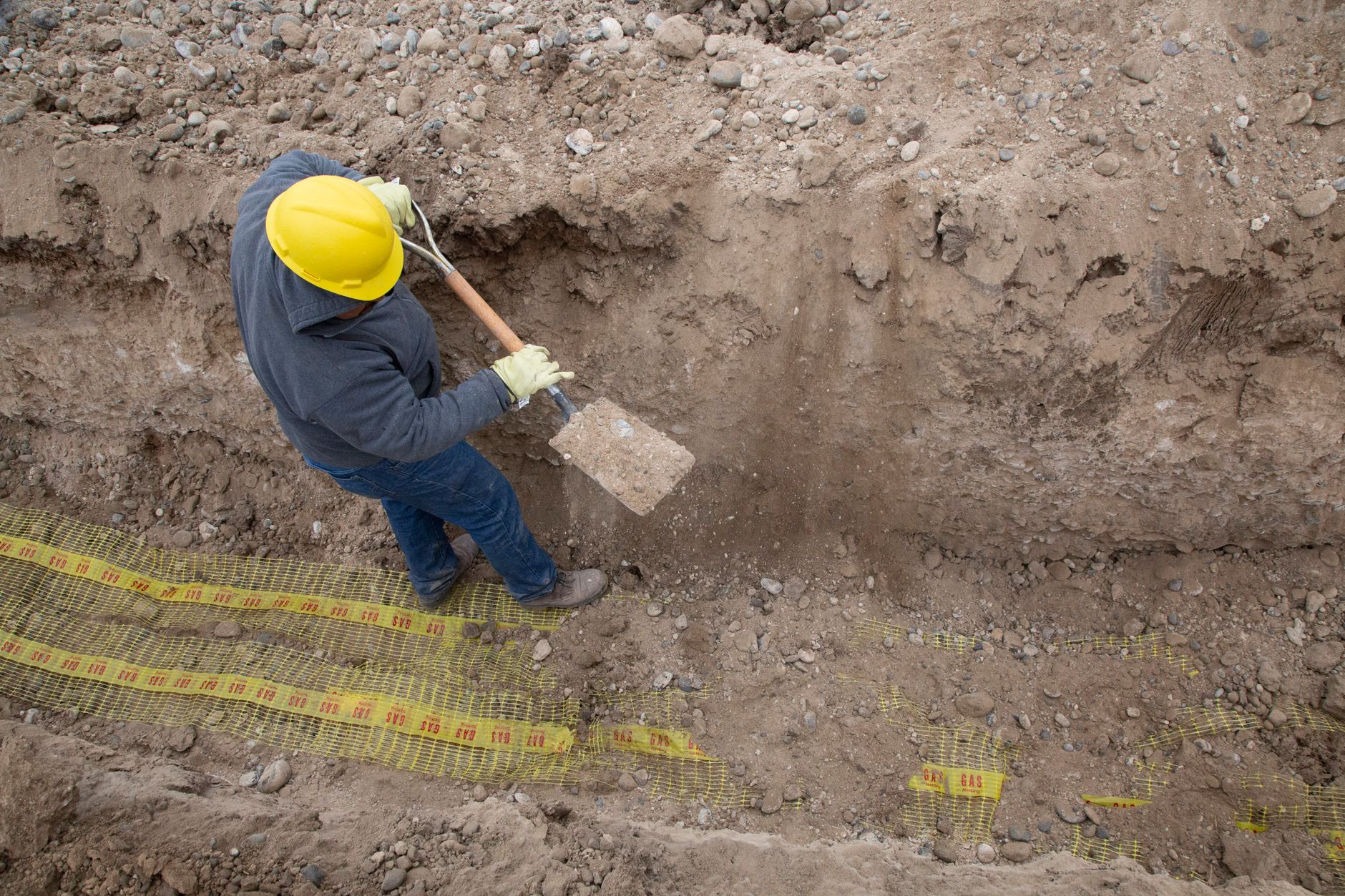
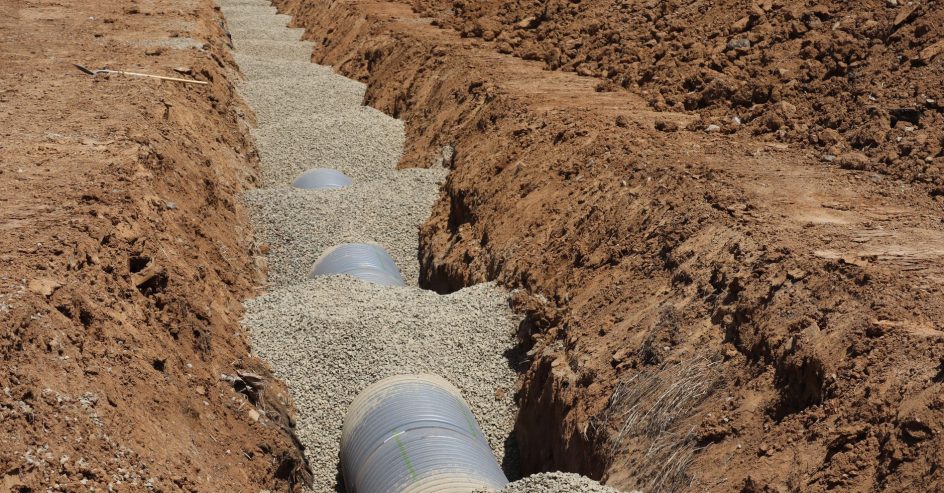
A French drain is a gravel-filled trench with a perforated pipe at the bottom that captures surface and subsurface water and moves it to a lower discharge point. French drains work in New Orleans when properly sized, properly wrapped, and discharged correctly. The standard New Orleans installation uses 4-inch perforated PVC pipe wrapped in landscape fabric, surrounded by 3/4-inch gravel, which prevents the fine clay particles in the surrounding soil from migrating into and clogging the pipe over time.
The critical variable in New Orleans is discharge. A French drain that terminates in a dry well, which relies on the surrounding soil to absorb the collected water, often underperforms in the city’s clay-heavy conditions because the surrounding soil simply cannot accept water fast enough. The most effective systems run to a street drain, catch basin, or approved SWBNO drainage structure. Systems that discharge to city infrastructure require a permit from the Sewerage and Water Board of New Orleans, and violations of SWBNO discharge rules can result in fines up to $500 per day.
For yards in the Marigny, Treme, or Bywater where pier-and-beam foundations are common in pre-1950 construction, French drains positioned along the perimeter protect the subfloor from chronic moisture exposure that accelerates wood rot and attracts termite activity. Properties in the Garden District and Uptown with older brick foundation walls benefit similarly from perimeter drainage that keeps soil moisture levels stable rather than cycling between saturated and dry.
French drain installation in New Orleans costs $25 to $39 per linear foot in 2026, according to data from Homeyou and HomeBlue. A typical residential project runs 60 to 100 linear feet, putting the total between $1,480 and $3,850 for materials and labor. More complex installs, including deep trenching in tight spaces, catch basin integration, or discharge to city infrastructure, push costs toward the higher end, with some projects reaching $5,992 or more. Louisiana overall runs about 10% below the national average for French drain installation, though New Orleans costs reflect the additional requirements that come with clay soil conditions and SWBNO coordination.
| Drainage Solution | Typical New Orleans Cost | Best For |
|---|---|---|
| Yard regrading | $800 to $4,000 | Yards where water pools due to flat or reversed grade |
| French drain (60 ft) | $1,480 to $2,340 | Subsurface water collection along fences, foundations |
| French drain (100 ft) | $2,470 to $3,850 | Larger lots, side-yard runs, full perimeter systems |
| Catch basin system | $2,500 to $7,000 | High-volume surface runoff, driveways, low spots |
| Dry well | $1,350 to $4,255 | Limited use in New Orleans due to clay soil and high water table |
Regrading the yard is sometimes the right first step before a French drain goes in. If the ground slopes toward the house rather than away from it, a French drain installed along the foundation will slow water intrusion but not eliminate it. Big Easy Renovations assesses yard grade during the site evaluation to determine whether drainage pipe alone solves the issue or whether regrading must happen first. The landscaping and drainage work the team handles includes both surface grading corrections and underground drainage installation across Greater New Orleans and surrounding parishes.
Grading fixes a water problem at the surface by reshaping the yard so water flows away from structures. A French drain fixes a water problem underground by capturing what the soil cannot absorb fast enough and routing it out. Most New Orleans flooding situations need one or the other, and some need both in sequence.
Signs that regrading is the primary fix:
Signs that a French drain is the primary fix:
Homeowners in Metairie and Kenner dealing with post-storm water often find that the combination works best: regrade the yard to direct surface flow, then install a French drain at the collection point to manage what the regraded soil channels in. Jefferson Parish Inspection and Code Enforcement oversees permits for drainage work in Metairie, Kenner, Gretna, and surrounding Jefferson Parish cities, and those requirements differ from Orleans Parish. Big Easy Renovations pulls the required permits before any drainage work begins across both Orleans and Jefferson Parish jurisdictions.
A properly installed French drain in New Orleans lasts 30 to 40 years when the pipe is wrapped in landscape fabric and the gravel backfill is correctly sized for local clay soil conditions. The primary failure mode in clay-heavy soils is silt migration into the gravel bed and eventually into the perforated pipe, which reduces flow capacity over time. Annual flushing of the system at the cleanout access point prevents that buildup and extends the effective lifespan significantly.
Cheaper installs that omit the landscape fabric wrapping, use undersized gravel, or skip the cleanout access point are the ones that fail in 5 to 10 years in New Orleans conditions. The investment difference between a properly specified system and a minimal one is often small relative to the cost of excavating and reinstalling a failed drain. When evaluating contractors, ask specifically whether the pipe will be sock-wrapped and what gravel size they use.
Properties on the North Shore, in Mandeville, Covington, or Madisonville, face similar clay soil profiles with the added challenge of pine root intrusion into drainage lines over time. St. Tammany Parish Permits and Inspections governs drainage work across the North Shore, and root-resistant pipe specifications matter more in wooded residential settings. Big Easy Renovations serves both South Shore and North Shore homeowners, which means the same contractor who fixes your drainage can also handle sod installation and lawn restoration after excavation work is complete. Similarly, homeowners who have dealt with peeling or blistering exterior surfaces after chronic moisture exposure often find that addressing the drainage first makes exterior painting results last significantly longer.
How much does a French drain cost in New Orleans?
French drain installation in New Orleans costs $25 to $39 per linear foot in 2026. A 60-foot system runs $1,480 to $2,340. Projects that include catch basins or SWBNO-permitted discharge connections can reach $5,000 to $7,000 depending on complexity and site conditions.
Why does my New Orleans yard stay wet for days after a storm?
New Orleans gumbo soil absorbs water at only 0.1 to 0.5 inches per hour. When the soil saturates during heavy rain, surface water has nowhere to go and sits until it evaporates. The high water table and ongoing subsidence in many neighborhoods reduce soil storage capacity further after every storm.
Do I need a permit for French drain installation in New Orleans?
French drains that infiltrate water entirely on-site typically do not require a SWBNO permit. Systems that discharge to city street drains or underground infrastructure require a permit from the Sewerage and Water Board of New Orleans. Big Easy Renovations coordinates all required permits across Orleans and Jefferson Parish before drainage work begins.
Does a French drain work in New Orleans clay soil?
French drains work in New Orleans clay soil when the pipe is wrapped in landscape fabric and the system discharges to an approved outlet rather than relying on infiltration. A dry well terminus usually underperforms in clay-heavy conditions because the surrounding soil cannot absorb collected water fast enough to prevent backups during heavy rain events.
What is causing my New Orleans yard to sink?
Yard sinking in New Orleans results from subsidence, the gradual compression of soft delta soils combined with groundwater pumping and organic matter decomposition below grade. A 2025 study found some neighborhoods losing nearly 2 inches of elevation annually. Properties that drained adequately a decade ago may now hold water because the grade has shifted.
Can regrading alone fix New Orleans yard flooding?
Regrading works when flooding is caused by a flat or reversed yard grade directing water toward the house. Adding soil to build slope away from the foundation costs $800 to $4,000. When the soil drains slowly regardless of grade, a French drain or catch basin is also needed to move collected water off the property.
Ready to stop dealing with standing water after every storm? Call Big Easy Renovations at (504) 294-8616 to schedule a drainage site evaluation. The team assesses yard grade, soil conditions, and existing drainage infrastructure, then recommends whether regrading, a French drain, a catch basin system, or a combination is the right solution for your property. Big Easy Renovations serves New Orleans, Metairie, Kenner, Gretna, Slidell, Mandeville, Covington, and surrounding parishes across Orleans, Jefferson, and St. Tammany Parish. Request a consultation online to get the process started.
Beyond drainage, the same crew that solves your yard flooding problem also handles paver patio and concrete slab installation once the drainage is sorted, and can restore lawn areas disturbed during excavation. Addressing drainage first means outdoor construction work holds up through the years of rain that follow.
What You Need to Know Composite decking outlasts pressure-treated wood by 15 to 35 years in New Orleans’ hot-humid subtropical climate, and it does so without the annual sealing, staining, o...
After hurricane roof damage in New Orleans, your first priorities are personal safety, preventing further water intrusion, and documenting everything before you touch it. Tarp exposed areas, photog...
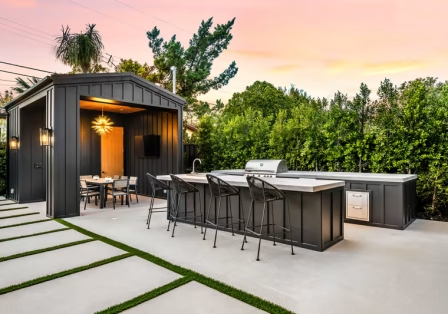
An outdoor kitchen in New Orleans costs $5,000 to $50,000 or more in 2026 depending on size, materials, appliances, and whether the project requires gas, water, and electrical connections. Big EZ R...

Big EZ Renovations applies professional roof coatings across Greater New Orleans, and the cost ranges from $0.50 to $7.00 per square foot installed in 2026 depending on the coating type, roof size,...

Ever wondered which room in your home could give you the best return on investment when renovated? You’re not alone. Home renovation is a consistent priority for New Orleans homeowners, many...
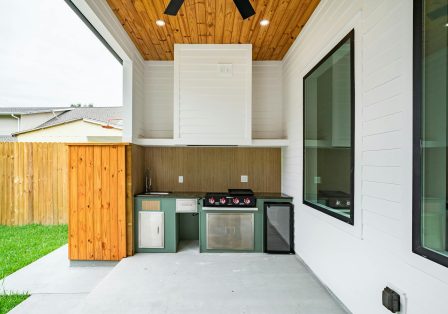
Quick Summary Planning an outdoor kitchen in New Orleans means designing for IECC Climate Zone 2A, a hot-humid environment that receives 61 inches of rain each year and exposes every outdoor surfa...
 By BigEZRenovations
  0 Comment
  Sep 15, 2026
  By
BigEZRenovations
By
BigEZRenovations  0 Comments