

Opening Hours Mon - Fri: 8:00 AM - 3:00 PMSat - Sun: Closed
New Orleans’ Trusted Renovation Experts — Transform Your
Home with Confidence- Get Your Free Estimate
Opening Hours Mon - Fri: 8:00 AM - 3:00 PMSat - Sun: Closed

Talk to an Expert504-294-8616
Opening Hours Mon - Fri: 8:00 AM - 3:00 PMSat - Sun: Closed

A FORTIFIED roof in Louisiana costs $4.40-$6.90 per square foot, or roughly $8,800-$13,800 for a 2,000 sq ft home, only 10-15% more than a standard replacement. The Louisiana Fortify Homes Program provides grants up to $10,000, and a state tax credit (Act 404, now in effect) offers an additional $10,000 for those who pay out-of-pocket. According to the Louisiana Legislative Auditor, homeowners with FORTIFIED roofs save a median of $1,250 annually (22%) on insurance premiums. With Louisiana’s median homeowners insurance now exceeding $13,900, the payback period on a FORTIFIED upgrade is often just 3 to 5 years.
Louisiana homeowners are paying some of the highest insurance premiums in the nation, second only to Florida. For many families, insurance now costs as much as their annual mortgage payment. But there’s a proven solution that reduces both your storm risk and your insurance costs: upgrading to a FORTIFIED roof.
FORTIFIED is a construction standard developed by the Insurance Institute for Business & Home Safety (IBHS) that makes roofs significantly more resistant to hurricane damage. Louisiana has become the fastest-growing FORTIFIED market in the country, with over 10,000 certified roofs installed statewide.
This guide explains what FORTIFIED certification means, how much it costs, how to access Louisiana’s grant and tax credit programs, and what insurance savings you can realistically expect. For a broader overview of roofing in our region, see our complete guide to roofing in New Orleans.
A FORTIFIED roof isn’t just a marketing term; it’s a specific construction standard backed by decades of research and real-world testing by the Insurance Institute for Business & Home Safety (IBHS).
IBHS operates the only research center in the world capable of full-scale building tests against hurricane-force winds. Their testing identified common failure points in conventional roofs and developed specific solutions to address each vulnerability.
The result is the FORTIFIED standard: a set of construction requirements that have been proven to dramatically reduce roof damage during hurricanes and severe storms.
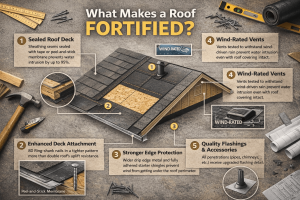
FORTIFIED roofs include several key upgrades over standard installations:
IBHS offers three levels of FORTIFIED designation:
| Level | What It Covers | Best For |
|---|---|---|
| FORTIFIED Roof | Roof system only (most common for existing homes) | Homeowners replacing their roof |
| FORTIFIED Silver | Roof + opening protection (windows, doors, garage) | Comprehensive storm protection |
| FORTIFIED Gold | Roof + openings + continuous load path to foundation | New construction or major renovation |
For most Louisiana homeowners replacing an existing roof, the FORTIFIED Roof designation provides the best balance of cost and protection and qualifies for state grants and insurance discounts.
One of the biggest misconceptions is that FORTIFIED roofs are dramatically more expensive than standard installations. The reality is more encouraging.
| Component | Standard Roof | FORTIFIED Roof |
|---|---|---|
| Base roof replacement | $7,000 to $15,000 | $7,000 to $15,000 |
| FORTIFIED upgrades | Not applicable | $1,500 to $3,500 |
| Evaluator fee | Not applicable | $300 to $600 |
| Total (2,000 sq ft home) | $7,000 to $15,000 | $8,800 to $18,600 |
According to the Louisiana Legislative Auditor’s report, the median total cost for a FORTIFIED roof upgrade is approximately $16,229. Of that:
In other words, if you’re already replacing your roof, the FORTIFIED premium is typically only $3,000-$3,500 more than a standard installation.
For detailed pricing on standard roof work, see our guide on roof repair costs in New Orleans.
In the New Orleans market, FORTIFIED roof installations typically run $4.40-$6.90 per square foot, compared to $3.50-$5.50 for standard architectural shingle installations.
Louisiana offers multiple incentives that can dramatically reduce or even eliminate your out-of-pocket cost for a FORTIFIED roof.
The Louisiana Fortify Homes Program provides grants up to $10,000 to help homeowners upgrade to FORTIFIED roofing standards. This is the primary state grant program and has funded over 10,000 roofs since its launch.
Eligibility Requirements:
How the Program Works:
Important: If you registered in 2024, 2025 or 2026, you’re automatically entered in future lottery rounds.
Key Details:
Who Should Use the Tax Credit vs. Grant?
Louisiana has enacted new legislation to strengthen long-term funding for FORTIFIED roof programs:
HB 329: Dedicated Funding (Effective July 1, 2026) Starting July 1, 2026, the first $5 million of certain surplus lines insurance tax collections will be dedicated to the Louisiana Fortify Homes Program Fund each fiscal year. This creates more predictable, stable funding for the grant program going forward.
Act 501: Insurance Fee Changes (Effective January 1, 2026) Increased certain fees collected by the Louisiana Department of Insurance, with portions directed toward resilience and grant programs for homeowners.
These changes signal Louisiana’s continued commitment to making FORTIFIED roofs accessible to more homeowners, though grant demand currently exceeds supply.
Some Louisiana parishes offer additional funding on top of state programs:
The financial case for FORTIFIED becomes even stronger when you factor in long-term insurance savings.
According to the Louisiana Legislative Auditor’s March 2025 report:
Note: Louisiana Citizens Property Insurance implemented rate changes effective January 1, 2026. If you’re a Citizens policyholder, review your renewal documents carefully and confirm whether FORTIFIED discounts are being applied correctly.
Let’s run the numbers for a typical scenario:
| Factor | Amount |
|---|---|
| Total FORTIFIED cost | $16,229 |
| LFHP grant | -$10,000 |
| Out-of-pocket cost | $6,229 |
| Annual insurance savings | $1,250 |
| Payback period | 5 years |
After 5 years, you’re saving $1,250+ annually for the remaining life of your roof (15 to 25 years depending on material), potentially saving $18,000-$30,000 over the roof’s lifespan. Learn more about how long roofs last in New Orleans to understand your long-term investment.
The IBHS FORTIFIED certificate is the only documentation you need to obtain the FORTIFIED roof discount from your insurance company. No additional wind mitigation forms are required.
Louisiana Department of Insurance Bulletin 2025-03 reminds all insurers and agents of their obligation to inform policyholders about available FORTIFIED discounts and apply them correctly.
If you believe your discount isn’t being applied properly, contact the LDI Office of Consumer Services at 1-800-259-5300. For general guidance on dealing with your insurance company, see our guide on how to file a roof insurance claim in Louisiana.
Getting FORTIFIED certified involves several steps and specific professionals. Here’s the complete process.
Before any work begins, you must hire a certified FORTIFIED Evaluator to assess your home. The evaluator will:
Evaluator fees typically run $300-$600 for the initial inspection, with a re-inspection fee after work is completed.
Your roofing contractor must be trained and credentialed to perform FORTIFIED installations. If you’re using the LFHP grant, you must select from the approved contractor roster.
As of November 1, 2025, IBHS requires that all FORTIFIED roofs be installed by a certified FORTIFIED roofing contractor. This is now mandatory for certification, not optional. Homeowners must hire an IBHS-approved contractor for the project to qualify for official FORTIFIED designation. This means who you hire is now just as important as how the roof is built.
What to Look For:
Big EZ Renovations can help you navigate the contractor selection process and provide detailed estimates for your FORTIFIED project.
During installation, the contractor must document each FORTIFIED requirement with photos:
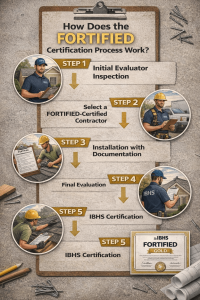
This documentation is submitted to the evaluator and ultimately to IBHS for review.
After the roof is complete, the evaluator returns to verify the installation meets all FORTIFIED requirements. They’ll compare the final condition to the required standards and submit documentation to IBHS.
IBHS reviews all documentation and issues your FORTIFIED designation certificate. Most projects are certified within days of final photo submission, depending on evaluator workload and documentation completeness.
Submit your FORTIFIED certificate to your insurance company to receive your premium discount. The certificate is valid for 5 years, after which a redesignation inspection is required to maintain your discount.
IBHS released the 2025 FORTIFIED Home Standard, which became mandatory on November 1, 2025. All roofs permitted or installed after this date must meet the updated requirements.
If you’re getting a quote, make sure your contractor is pricing to the current 2025 standard and holds active FORTIFIED certification.
FORTIFIED certification is compatible with most roofing materials, but some perform better than others in Louisiana’s climate.
For a detailed comparison of how different materials perform in our climate, see our guide on the best roofing materials for Louisiana.
If you’re unsure whether your roof needs replacement, our guide on roof repair vs. replacement can help you make the right decision.
Beyond the financial savings, many homeowners cite peace of mind as the biggest benefit. As Louisiana Insurance Commissioner Tim Temple noted: “That’s one thing we don’t talk about enough. We talk about the discounts but peace of mind is very important as well.”
Knowing your roof was built to withstand hurricane-force winds, and tested by independent evaluators to verify it, provides security that’s hard to put a price on.
Even FORTIFIED roofs can sustain damage in extreme storms. If you experience hurricane or storm damage:
Our detailed guide on hurricane roof damage recovery walks you through the complete process.
Big EZ Renovations helps New Orleans homeowners navigate the entire FORTIFIED process, from initial evaluation through final certification.
Call 504-294-8616 for a free FORTIFIED roof consultation, or contact us online.
Potentially, yes. If your total project cost is $10,000 or less and you receive the full LFHP grant, your out-of-pocket cost could be zero. Jefferson Parish residents can access an additional $5,000 through RELIF for up to $15,000 total. Orleans Parish homeowners under 80% AMI may qualify for up to $35,000 through CDBG.
After grant approval, you must begin work within 90 days. Most roof installations take 1-3 days on site, weather permitting. Certification typically follows within days of final documentation submission.
Yes. If using the Louisiana Fortify Homes Program grant, you must select a contractor from the LFHP-approved roster. Additionally, as of November 1, 2025, all FORTIFIED projects (grant or not) require a certified FORTIFIED roofing contractor for the project to qualify for official IBHS certification. Verify credentials on the program portal before signing any contract.
Initial FORTIFIED certificates are valid for 5 years. At expiration, a redesignation inspection is required to maintain the designation and associated insurance discounts. If no substantial changes have been made and the roof is in good condition, redesignation is typically straightforward.
In most cases, no. The FORTIFIED requirements for sealed deck, enhanced attachment, and upgraded edge details require access to the roof deck, which means removing existing shingles. FORTIFIED is typically done as part of a full roof replacement.
This is important. FORTIFIED (uppercase) is the trademarked IBHS program that includes certification, third-party verification, and insurance discounts. A “fortified roof” (lowercase) may refer to any roof using some strengthening techniques but doesn’t include certification and won’t qualify for insurance discounts.
As of early 2026, lottery registration is closed. The Louisiana Department of Insurance opens registration windows periodically throughout the year. Subscribe to notifications at ldi.la.gov/fortifyhomes to be alerted when the next window opens. Prepare your documentation in advance so you can register immediately.
Louisiana homeowners typically have 180 days to file a roof insurance claim after hurricane damage. Insurance companies must begin adjusting your claim within 14 days (or 30 days after a catastroph...
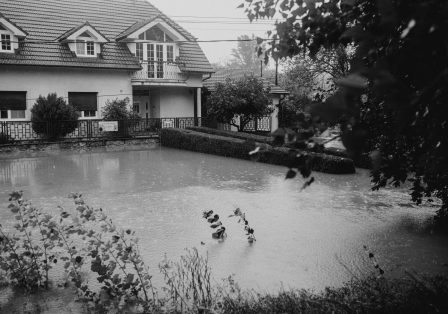
Why Water Sits in New Orleans Yards After a Storm New Orleans receives roughly 64 inches of rain per year, and most of it falls in short, intense bursts. When two inches drop in under an hour, eve...

Ever wondered which room in your home could give you the best return on investment when renovated? You’re not alone. Home renovation is a consistent priority for New Orleans homeowners, many...
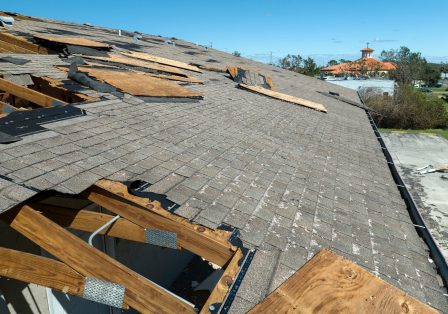
After hurricane roof damage in New Orleans, your first priorities are personal safety, preventing further water intrusion, and documenting everything before you touch it. Tarp exposed areas, photog...
Quick Summary Ornamental iron gates are a defining feature of New Orleans architecture, but the city’s hot-humid climate, classified as IECC Climate Zone 2A, and annual average humidity of 7...
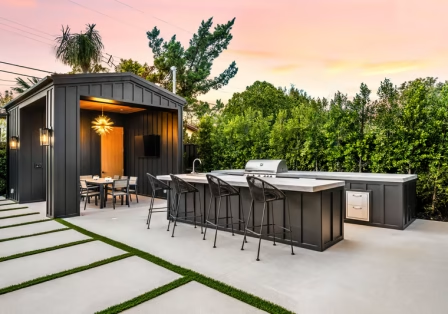
An outdoor kitchen in New Orleans costs $5,000 to $50,000 or more in 2026 depending on size, materials, appliances, and whether the project requires gas, water, and electrical connections. Big EZ R...
 By BigEZRenovations
  0 Comment
  Mar 9, 2026
  By
BigEZRenovations
By
BigEZRenovations  0 Comments