

Opening Hours Mon - Fri: 8:00 AM - 3:00 PMSat - Sun: Closed
New Orleans’ Trusted Renovation Experts — Transform Your
Home with Confidence- Get Your Free Estimate
Opening Hours Mon - Fri: 8:00 AM - 3:00 PMSat - Sun: Closed

Talk to an Expert504-294-8616
Opening Hours Mon - Fri: 8:00 AM - 3:00 PMSat - Sun: Closed

Quick Summary
Cellulose insulation absorbs moisture from New Orleans’s ambient humidity, compresses over time, and loses the R-value it was installed to deliver, making it a poor long-term choice for attics in IECC Climate Zone 2A. Big Easy Renovations installs attic insulation across Greater New Orleans, Jefferson Parish, and St. Tammany Parish under Residential Contractor License #890459 issued by the Louisiana State Licensing Board for Contractors (LSLBC), with material selection calibrated to Zone 2A thermal and moisture performance requirements. The minimum attic insulation R-value for New Orleans under the current energy code is R-38, and spray foam outperforms cellulose in this climate because it provides an air barrier and moisture resistance in addition to thermal resistance. Homeowners comparing attic insulation quotes in Greater New Orleans should ask specifically how each contractor addresses Zone 2A humidity before any material is installed.
Last Updated: June 2026
Cellulose insulation is one of the most widely quoted attic materials in the country, but in New Orleans it consistently underperforms. IECC Climate Zone 2A, the hot-humid classification governing Greater New Orleans and the surrounding parishes, creates attic conditions where outdoor air routinely carries moisture into unconditioned spaces. Cellulose absorbs that moisture, compresses under its own weight over time, and loses the R-value it was installed to deliver. Big Easy Renovations handles attic insulation upgrades across Orleans, Jefferson, and St. Tammany parishes, and the material and installation approach that performs reliably in Zone 2A differs significantly from what works in drier northern markets.
Big Easy Renovations is licensed under both Residential License #890459 and Commercial Contractor License #3667 by the Louisiana State Licensing Board for Contractors, covering attic insulation alongside roofing, siding, and interior renovation. The climate specificity of insulation work in New Orleans matters more than most homeowners expect: a contractor trained in northern markets who installs a vapor retarder on the wrong side of the assembly in Zone 2A creates condensation problems inside the building envelope that cost far more to fix than the original insulation job.
New Orleans housing stock adds a layer of complexity that most national insulation guides do not address. Shotgun houses, Creole cottages, and other pre-1950 structures in the Marigny, Bywater, Mid-City, Lakeview, and Garden District neighborhoods often sit on pier-and-beam foundations and have attic configurations that differ from the slab-on-grade homes most product specifications are written for. In a raised home, the attic and the subfloor are both thermal loss points, and addressing one without the other produces incomplete results regardless of which insulation product is installed.
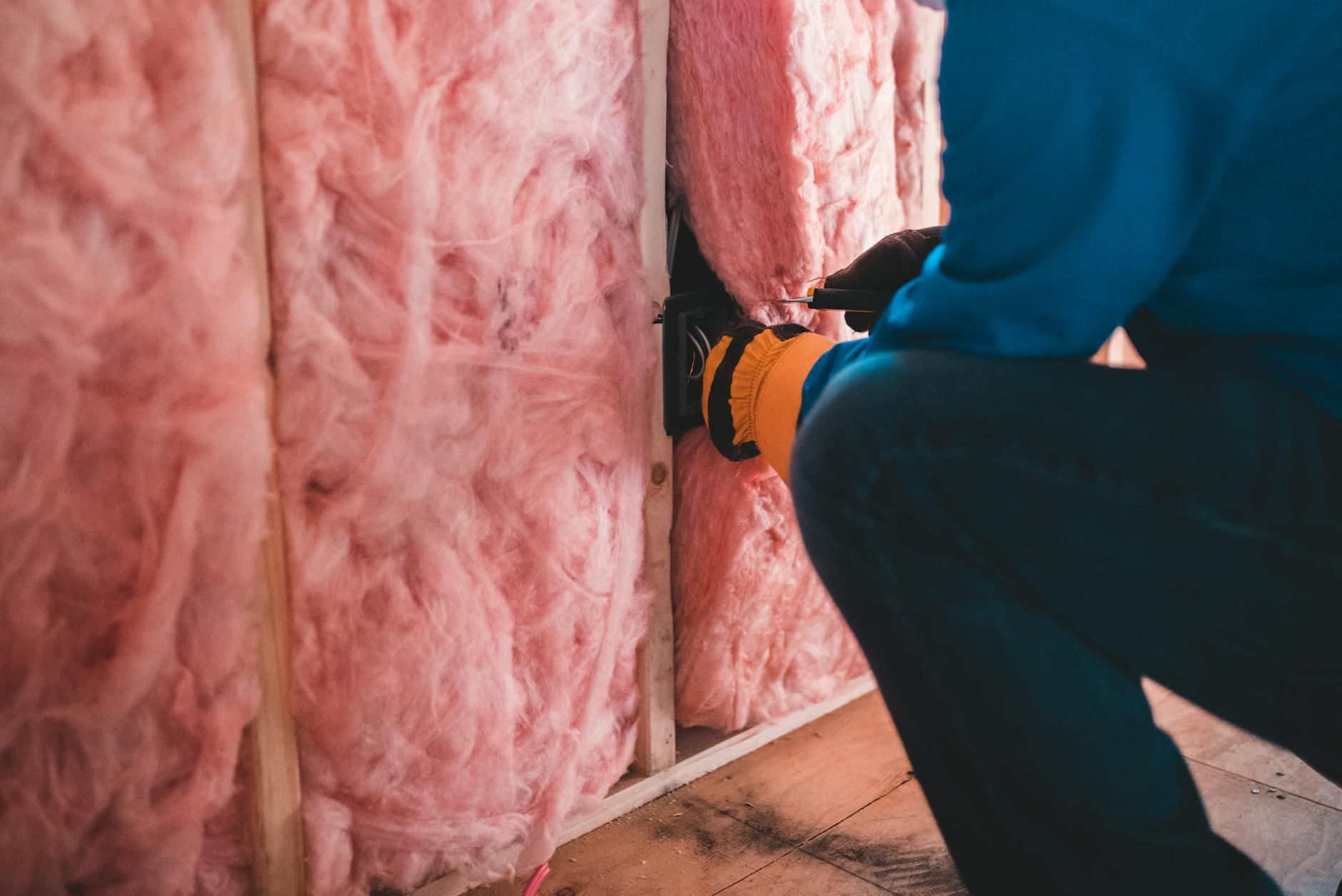
Cellulose fails in New Orleans attics because it is made from recycled paper fiber with no inherent resistance to liquid water or vapor. In Zone 2A attics where outdoor relative humidity routinely exceeds 80% during summer months, cellulose draws in moisture through every air gap in the attic floor assembly. Once wet, it loses R-value and stays wet long enough to support mold growth at the base of the insulation layer where it contacts the attic floor.
The problem accelerates as cellulose settles. All loose-fill cellulose compresses under its own weight over time, reducing the installed depth and the effective R-value along with it. An installation rated at R-38 at the time of install can perform at R-28 or lower within a decade in a Louisiana attic where periodic moisture absorption combines with gravitational settling. That gap between rated and actual performance drives up cooling costs during June through September and is rarely visible without pulling back the material to measure remaining depth.
Cellulose also provides no air barrier. In Zone 2A, where warm, moisture-laden outdoor air pushes through gaps in the building envelope continuously during summer, an insulation material that sits loose on the attic floor without stopping airflow allows that moisture to migrate into the conditioned living space. Spray foam addresses this in a single application: it expands to fill gaps and adheres to the substrate, functioning as the insulation, the air seal, and a moisture retarder simultaneously.

IECC Climate Zone 2A requires a minimum attic insulation R-value of R-38 for Greater New Orleans under the current adopted energy code. R-38 is the thermal resistance threshold at which the attic assembly provides meaningful resistance to the heat load driving cooling demand through south Louisiana summers. Installing below R-38 on a new project or full attic replacement means the work does not meet the code minimums enforced by the Orleans Parish Building Department or Jefferson Parish Inspection and Code Enforcement.
Spray foam outperforms cellulose in every performance category that matters in New Orleans: air sealing, moisture resistance, long-term R-value stability, and resistance to settling. Closed-cell spray foam also acts as a Class II vapor retarder, which is particularly relevant in Zone 2A where moisture control is the primary failure mechanism for attic assemblies. The tradeoff is upfront cost, but the performance gap over a 15- to 20-year window in Louisiana conditions makes spray foam the more economical choice for most homeowners who plan to remain in the home.
| Property | Cellulose | Open-Cell Spray Foam | Closed-Cell Spray Foam |
|---|---|---|---|
| Air barrier | No | Yes | Yes |
| Moisture resistance | Low | Moderate | High |
| R-value per inch | R-3.2 to R-3.8 (when dry) | R-3.7 to R-3.9 | R-6 to R-7 |
| Settles over time | Yes | No | No |
| Recommended for Zone 2A attics | Not recommended | Yes, attic floors and interior cavities | Yes, rooflines, rim joists, and subfloors |
Homeowners who are upgrading to a FORTIFIED roof system through the Louisiana Fortify Homes Program are well-positioned to upgrade attic insulation during the same project. A new roof installation exposes the attic assembly for inspection, and combining both upgrades avoids disturbing completed roofwork later.
Raised homes on pier-and-beam foundations, common in the Marigny, Treme, Mid-City, Lakeview, and Garden District neighborhoods of New Orleans, require insulation at both the attic floor level and the subfloor level for complete thermal coverage. Treating only the attic without addressing the subfloor leaves a significant thermal bypass at the base of the home, where unconditioned crawl space air contacts the uninsulated floor assembly from below.
For raised homes, closed-cell spray foam is the preferred material for the subfloor and rim joist assembly because it creates an impermeable moisture barrier at the point where Gulf Coast humidity and ground moisture are most likely to enter the building envelope. Homes that show signs of prior water intrusion or sheathing damage from storms such as Hurricane Ida (2021) or Hurricane Zeta (2020) should have the attic assembly inspected and dried before new insulation is installed. Homeowners who experienced storm or hail damage that reached the attic sheathing should confirm the substrate is structurally sound and fully dry before scheduling an insulation upgrade.
Attic insulation costs in Greater New Orleans vary based on material type, attic size, and whether air sealing work is included. Most completed projects in the local market fall between $700 and $1,900 for standard insulation, with spray foam projects running higher because of material cost per square foot. Per-square-foot cost ranges for 2025 and 2026 New Orleans market conditions are as follows:
Entergy Louisiana previously offered residential energy efficiency rebates through the Entergy Solutions program that offset insulation upgrade costs. As of early 2026, that program is on hold with no published restart date or confirmed measure list. Homeowners should verify current program status at Entergy Louisiana’s energy efficiency page before planning a project around expected rebates. The federal Energy Efficient Home Improvement Credit (25C) remains active and covers 30% of qualifying insulation costs up to $1,200 annually. For homeowners also evaluating moisture-resistant siding on exterior walls, coordinating both projects with a single licensed contractor simplifies permitting and material scheduling.
Please note: The prices in this article are estimates only, shared to help you plan. Your actual cost depends on your property, the materials and the size of the job. For pricing on your project, call Big EZ Renovations for a quote.
Why is cellulose insulation a poor choice for New Orleans attics?
Cellulose is made from recycled paper fiber and absorbs moisture from the ambient humidity of IECC Climate Zone 2A. Once wet, it loses R-value and creates conditions for mold growth at the insulation base. It also settles over time, reducing depth and performance below the R-38 minimum required by the current energy code for attics in Greater New Orleans.
What R-value does New Orleans require for attic insulation?
IECC Climate Zone 2A requires a minimum attic insulation R-value of R-38 in Greater New Orleans, Jefferson Parish, and surrounding areas under the current adopted energy code. Projects that fall below R-38 on a new install or full replacement do not meet the code minimums enforced by the Orleans Parish Building Department or Jefferson Parish Inspection and Code Enforcement.
Is spray foam better than cellulose for a Louisiana attic?
Yes. Spray foam creates an air barrier and moisture resistance that cellulose cannot match in Zone 2A conditions. Open-cell spray foam is effective for attic floors, while closed-cell is preferred for rooflines, rim joists, and subfloor assemblies in raised homes. Spray foam does not settle or lose R-value from moisture absorption the way loose-fill cellulose does over a decade of Zone 2A exposure.
Do shotgun houses in New Orleans need attic and subfloor insulation?
Yes. Raised homes on pier-and-beam foundations, including most shotgun houses and Creole cottages in older New Orleans neighborhoods, lose conditioned air through both the attic floor above and the subfloor below. Insulating only the attic without addressing the subfloor assembly leaves a thermal bypass at the foundation level where Gulf Coast humidity enters the building envelope from below.
Are Entergy Louisiana insulation rebates available in 2026?
As of early 2026, Entergy Louisiana’s Entergy Solutions program is on hold with no confirmed restart date or published rebate amounts. Big Easy Renovations recommends homeowners check Entergy Louisiana’s energy efficiency page for current status before planning around expected rebates. The federal 25C Energy Efficient Home Improvement Credit remains active and covers 30% of qualifying insulation costs up to $1,200 annually.
What insulation problems should I look for after hurricane damage in New Orleans?
After storm damage, attic insulation should be inspected for moisture saturation, mold growth at the insulation base, and displacement from roof or sheathing failure. Cellulose and fiberglass insulation wetted by storm intrusion must be removed and replaced before new material is installed. Installing over wet or moldy insulation traps moisture permanently inside the attic assembly and accelerates structural decay in the sheathing and rafters.
Ready to upgrade your attic insulation? Call Big Easy Renovations at (504) 294-8616 to schedule an attic assessment. The team evaluates existing insulation, air sealing needs, and substrate condition before recommending materials matched to IECC Climate Zone 2A requirements across New Orleans, Metairie, Kenner, and the surrounding parishes. Homeowners who prefer to send project details first can connect with the team through the website for a prompt response.
Quick Summary A New Orleans roof with isolated damage on a single section and fewer than 15 years of service can usually be repaired rather than replaced. Big Easy Renovations, licensed by the Lou...
Quick Summary Planning an outdoor kitchen in New Orleans means designing for IECC Climate Zone 2A, a hot-humid environment that receives 61 inches of rain each year and exposes every outdoor surfa...

Quick Summary Ornamental iron gates are a defining feature of New Orleans architecture, but the city’s hot-humid climate, classified as IECC Climate Zone 2A, and annual average humidity of 7...
Quick Summary Bathroom renovation in New Orleans, Louisiana requires a permit from the Orleans Parish Department of Safety and Permits before any plumbing, electrical, or structural work begins. M...
Quick Summary In Greater New Orleans, Louisiana, homeowners choosing between asphalt shingles and standing seam metal roofing face real differences in wind resistance, upfront cost, and how each m...
After hurricane roof damage in New Orleans, your first priorities are personal safety, preventing further water intrusion, and documenting everything before you touch it. Tarp exposed areas, photog...
 By BigEZRenovations
  0 Comment
  Jun 2, 2026
  By
BigEZRenovations
By
BigEZRenovations  0 Comments